Not All Problems Need AI: Why We Chose MCDM Over Modern AI
- Jaime Parra
- Jul 31, 2025
- 3 min read

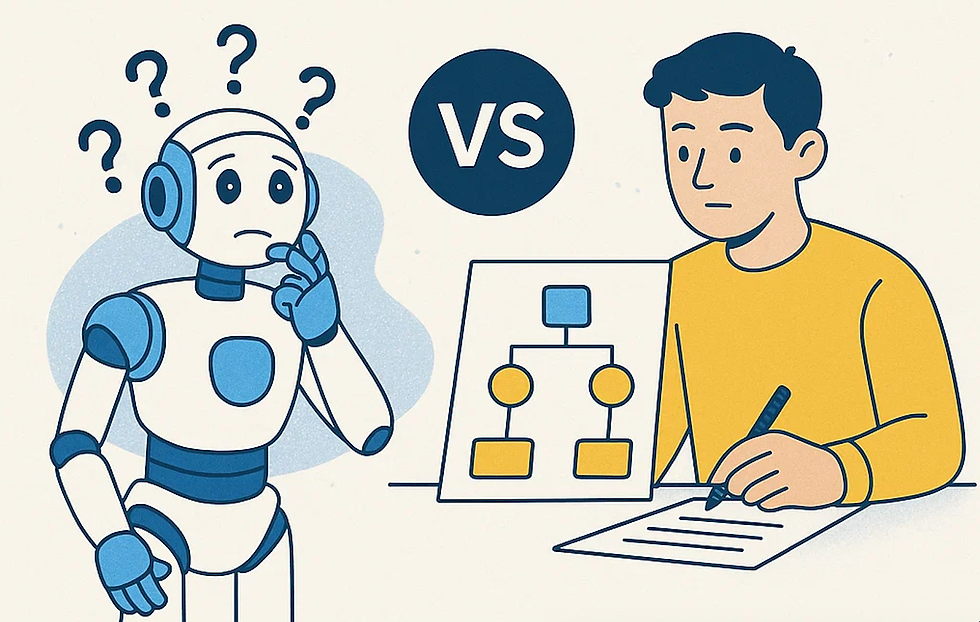
In today's technology landscape, there's an undebatable pressure to integrate artificial intelligence into every solution we develop. The equation seems simple: AI = innovation, and innovation = success. But after working in critical military and defense applications, we've learned that this narrative isn't always accurate.
Our team at SKIOS recently faced a problem that perfectly demonstrates this point. We are developing a decision-making system built on a neuro-symbolic architecture – a hybrid approach that combines neural networks with symbolic reasoning.
Our system can successfully analyze complex environmental data and suggest the best course of action (COA) from multiple options, with full traceability of the reasoning process. However, we faced a new challenge when implementing a new module within this architecture.
Let's see a, somehow, simplified example: once our system selects a COA like "LAUNCH_AIRCRAFT," we need to determine optimal execution parameters. Which airbase should launch the aircraft? Which specific aircraft should be selected? Sounds simple, right? But here's the challenge: the "best" option wasn't always determined by the same criteria or weights.
Each case was unique, requiring experts to decide what weight each criterion should have based on the specific situation. Furthermore, our criteria like distance_to_target, fuel_status, and aircraft_speed weren't simple yes-or-no values – we needed to perform mathematical calculations to determine them, and every step had to be completely transparent and explainable to keep our decision clear. Like most teams today, our first insight was to explore AI solutions and extend our neuro layer we already have. However, working in fields where lives depend on our system, we have non-negotiable requirements and we set the bar high for our applied criteria. After extensive research, we noticed a fundamental realization: an AI solution wouldn't align with our specific requirements. Our problem was that every case presented different criteria without patterns that AI could learn from. We needed mathematical precision and full traceability, not predictive algorithms, where we can know why this option is selected and not another option that is very similar.
This drove us to Multi-Criteria Decision Making, commonly known as MCDM. While it doesn't have the marketing appeal or aura of artificial intelligence, MCDM proved to be the perfect fit for our needs. This field within operations research specializes in making optimal decisions when multiple, often conflicting, criteria must be considered simultaneously.
MCDM works in two main ways. The first approach helps when you're trying to balance multiple goals at once – like finding the sweet spot between cost, quality, and speed. The second approach was perfect for our situation: comparing a specific list of options against different criteria. Think of it like choosing between different cars by weighing factors like price, fuel efficiency, safety ratings, and features. MCDM offers several proven methods to handle these comparisons, with tools like AHP (Analytic Hierarchy Process) and TOPSIS.
What makes MCDM particularly valuable for our case is its inherent transparency. Every step in the decision-making process is mathematically explicit and auditable. When our module selects an option, we can trace exactly how each criterion was weighted, how alternatives were evaluated, and why the final choice was made. This level of explainability is essential when decisions impact mission success and human lives.
The broader lesson extends far beyond our specific use case. In our rush to embrace the latest technological trends, we sometimes overlook fundamental questions: Does this technology solve our actual problem? Can we trust and verify its outputs? Does it align with our requirements?
Our experience strengthens a principle that guides all our R&D efforts at SKIOS: we don't implement AI simply to claim we're using the latest trends in artificial intelligence. We implement what works best for each unique challenge. Sometimes that means choosing cutting-edge machine learning algorithms, and sometimes it means returning to time-tested methodologies that have proven their reliability over decades.
As we continue developing systems for critical applications, this experience has strengthened our commitment to choosing the right tool for each specific problem. The measure of our success isn't whether we've implemented the most trending algorithms, but whether we've delivered systems that perform flawlessly when it matters most. Sometimes, that means having the confidence to choose proven fundamentals over popular innovations.



Comments